\r\n"}},{"@type":"Question","name":"How difficult is the Mera Peak climbing?","acceptedAnswer":{"@type":"Answer","text":"
The Mera Peak Climbing is considered a challenging high-altitude trekking and climbing adventure due to its elevation of 6,476 meters (21,247 feet) and demanding Himalayan conditions. However, it is classified as a non-technical trekking peak, making it achievable for physically fit trekkers with proper preparation, acclimatization, and basic mountaineering training.
\r\n\r\n
The main challenges of Mera Peak Climbing are the high altitude, long trekking days,cold temperatures, and glacier travel rather than difficult technical climbing. Climbers should be comfortable using basic mountaineering equipment such as crampons, an ice axe, and a climbing harness.
\r\n\r\n
With a positive attitude, good physical fitness, appropriate training, and guidance from an experienced Sherpa climbing team, Mera Peak can be successfully climbed by enthusiastic beginners as well as experienced mountaineers.
"}},{"@type":"Question","name":"Is the Kathmandu–Lukla flight included? Do I need to fly from another airport?","acceptedAnswer":{"@type":"Answer","text":"
Yes, the Kathmandu–Lukla or Ramechhap–Lukla round-trip airfare is included in our 18-day Mera Peak Climbing package.
\r\n\r\n
During the peak trekking seasons of March–April and October–November, Lukla flights are often operated from Ramechhap (Manthali) Airport due to increased air traffic at Kathmandu Airport. In this case, we provide a comfortable overland transfer between Kathmandu and Ramechhap, and the transportation cost is included in the Mera Peak Climbing package.
\r\n\r\n
During the remaining months, flights generally operate directly between Kathmandu and Lukla, making the journey more convenient without the need for a transfer to Ramechhap.
\r\n\r\n
Our team will arrange all necessary transportation and flight arrangements according to the current airline schedule, ensuring a smooth start and finish to your Mera Peak Expedition.
"}},{"@type":"Question","name":"How difficult is Mera Peak Climbing?","acceptedAnswer":{"@type":"Answer","text":"
Mera Peak Climbing is considered a challenging high-altitude trekking and climbing adventure because of its elevation, remote location, long trekking days, and changing Himalayan weather conditions. Standing at 6,476 meters (21,247 feet), Mera Peak requires good physical fitness, proper acclimatization, and mental determination.
\r\n\r\n
Although Mera Peak is a high-altitude summit, it is classified as a non-technical trekking peak. The main challenges are related to altitude, endurance, glacier travel, and cold temperatures rather than complex technical climbing. Basic mountaineering skills, including the use of an ice axe, crampons, a climbing harness, and rope techniques, are required for the summit section.
\r\n\r\n
With adequate preparation, regular physical training, proper acclimatization, and guidance from experienced Sherpa climbing guides, Mera Peak can be successfully climbed by fit trekkers, including those with limited previous mountaineering experience.
"}},{"@type":"Question","name":"What is the best time to climb Mera Peak?","acceptedAnswer":{"@type":"Answer","text":"
The best time for Mera Peak Climbing is during the spring (March to May) and autumn (September to November) seasons. These periods offer the most favorable weather conditions, stable temperatures, clear skies, and excellent mountain visibility, making them ideal for trekking and summit attempts.
\r\n\r\n
Spring (March–May) is a popular climbing season with warmer temperatures, blooming rhododendron forests, and good conditions for high-altitude climbing. Autumn (September–November) is considered the best overall season due to dry weather, clear views, and stable conditions in the Himalayas.
\r\n\r\n
Although these are the busiest trekking and climbing seasons, the reliable weather and stunning panoramic mountain views make them the most recommended times to attempt the Mera Peak Climbing.
\r\n\r\n
Winter (December–February) is possible for experienced climbers who are prepared for extreme cold and more challenging conditions, while the monsoon season (June–August) is generally less suitable due to rain, cloud cover, and flight disruptions.
"}},{"@type":"Question","name":"What permits are required for the Mera Peak Expedition?","acceptedAnswer":{"@type":"Answer","text":"
To climb Mera Peak, you need several permits and official documents required by the Government of Nepal. The main permits include a Mera Peak Climbing Permit issued through the Nepal Mountaineering Association (NMA) and a Sagarmatha National Park Entry Permit.
\r\n\r\n
You will also need a Khumbu Pasang Lhamu Rural Municipality permit for trekking in the Everest region. These permits help support conservation, local development, and the management of trekking and climbing activities in Nepal’s Himalayan regions.
\r\n\r\n
All necessary permits for the Mera Peak Expedition are arranged by Nepal Spirit Adventure as part of your climbing package. Our team handles the paperwork and permit procedures, allowing you to focus on your preparation and enjoy a smooth trekking and climbing experience in the Himalayas.
"}},{"@type":"Question","name":"How long does it take to climb Mera Peak?","acceptedAnswer":{"@type":"Answer","text":"
The Mera Peak Expedition typically takes around 14 to 18 days, including the trek to and from the mountain, acclimatization days, climbing preparation, and the summit attempt. The exact duration may vary depending on the chosen itinerary, weather conditions, flight schedules, and the overall pace of the trekking group.
\r\n\r\n
A well-planned Mera Peak Climbing itinerary includes sufficient time for acclimatization to help your body adjust to the high altitude and increase the chances of a successful summit. The standard route begins with a scenic flight to Lukla, followed by trekking through the remote Khumbu region before reaching Mera Base Camp and making the summit attempt.
\r\n\r\n
Factors such as individual fitness level, previous trekking experience, altitude adaptation, and Himalayan weather conditions can influence the overall length of the expedition. Allowing some flexibility in your schedule is highly recommended to handle possible weather delays and ensure a safer, more enjoyable Mera Peak climbing experience.
"}},{"@type":"Question","name":"What gear is required for the Mera Peak Climb?","acceptedAnswer":{"@type":"Answer","text":"
Proper equipment is essential for a safe and successful Mera Peak Climbing adventure. Since Mera Peak is a high-altitude Himalayan climb, you need suitable trekking and mountaineering gear to handle cold temperatures, glacier conditions, and changing mountain weather.
\r\n\r\n
The essential gear required for the Mera Peak Expedition includes:
\r\n\r\n
\r\n\t
Mountaineering boots suitable for crampons
\r\n\t
Crampons
\r\n\t
Ice axe
\r\n\t
Climbing harness
\r\n\t
Helmet
\r\n\t
Carabiners and climbing ropes
\r\n\t
Warm and waterproof clothing layers
\r\n\t
Down jacket and insulated gloves
\r\n\t
Quality trekking boots
\r\n\t
Sleeping bag suitable for cold temperatures
\r\n\t
Backpack and daypack
\r\n\t
Headlamp with extra batteries
\r\n\t
Sunglasses and sun protection
\r\n\t
Water bottle or hydration system
\r\n\t
Personal first-aid and medication supplies
\r\n
\r\n\r\n
Some technical climbing equipment may be provided by Nepal Spirit Adventure, depending on your package arrangement. We recommend checking the complete equipment list with your trekking agency before departure to ensure you have everything required for a comfortable and safe summit attempt.
\r\n\r\n
If you are unsure about any climbing equipment, our experienced trekking and climbing team can provide expert advice and help you prepare properly for your Mera Peak Climbing journey.
"}},{"@type":"Question","name":"Is prior mountaineering experience required for the Mera Peak Expedition?","acceptedAnswer":{"@type":"Answer","text":"
Prior mountaineering experience is not mandatory for the Mera Peak Expedition, but having previous trekking or climbing experience is certainly an advantage. Mera Peak is considered a non-technical trekking peak, although the summit involves glacier travel and requires basic mountaineering skills.
\r\n\r\n
Climbers should be familiar with essential techniques such as using an ice axe, crampons, a climbing harness, and rope systems. For those with limited climbing experience, our experienced Sherpa climbing guides provide basic training and guidance before the summit attempt to help you safely use the required equipment.
\r\n\r\n
The most important requirements for Mera Peak Climbing are good physical fitness, proper preparation, a positive mindset, and the ability to adapt to high-altitude conditions. With adequate training, acclimatization, and professional support, fit trekkers with little or no previous mountaineering experience can successfully attempt the Mera Peak summit.
"}},{"@type":"Question","name":"What is the accommodation like during the Mera Peak Climbing?","acceptedAnswer":{"@type":"Answer","text":"
During the Mera Peak Expedition, accommodation is provided in a combination of comfortable hotels, traditional teahouses, and expedition tents, depending on the location and stage of the journey.
\r\n\r\n
In Kathmandu, you will stay in a comfortable hotel with modern facilities. During the trekking portion, accommodation is arranged in local teahouses (mountain lodges), which provide a simple but authentic Himalayan experience. Teahouses usually offer twin-sharing rooms, shared bathroom facilities, dining areas, and warm meals.
\r\n\r\n
During the climbing section, especially near Mera Base Camp and High Camp, accommodation is provided in well-organized expedition tents. Our climbing crew arranges the necessary camping setup to ensure you have a safe and comfortable environment before your summit attempt.
"}},{"@type":"Question","name":"How much does it cost to climb Mera Peak?","acceptedAnswer":{"@type":"Answer","text":"
The cost of Mera Peak Climbing varies depending on the itinerary, group size, season, and services included in the package. On average, a complete Mera Peak Expedition package can cost around USD 2290 to USD 5,000 per person.
\r\n\r\n
The total cost generally includes essential services such as Mera Peak climbing permits, trekking permits, accommodation, meals during the trek and climb, domestic flights, experienced trekking and climbing guides, porters, camping arrangements, and necessary support staff.
\r\n\r\n
Additional expenses may include international flights, travel insurance, personal climbing equipment, extra hotel nights in Kathmandu, personal expenses, charging facilities, snacks, and tips for the trekking crew.
\r\n\r\n
Choosing a reliable and experienced trekking agency is important, as a lower-cost package may not always include the necessary safety measures, experienced guides, quality equipment, or proper support required for a successful high-altitude expedition.
\r\n\r\n
For an accurate price, it is best to check the detailed Mera Peak Climbing itinerary and package inclusions based on your preferred travel dates and services.
"}},{"@type":"Question","name":"What is the route for the Mera Peak Climbing?","acceptedAnswer":{"@type":"Answer","text":"
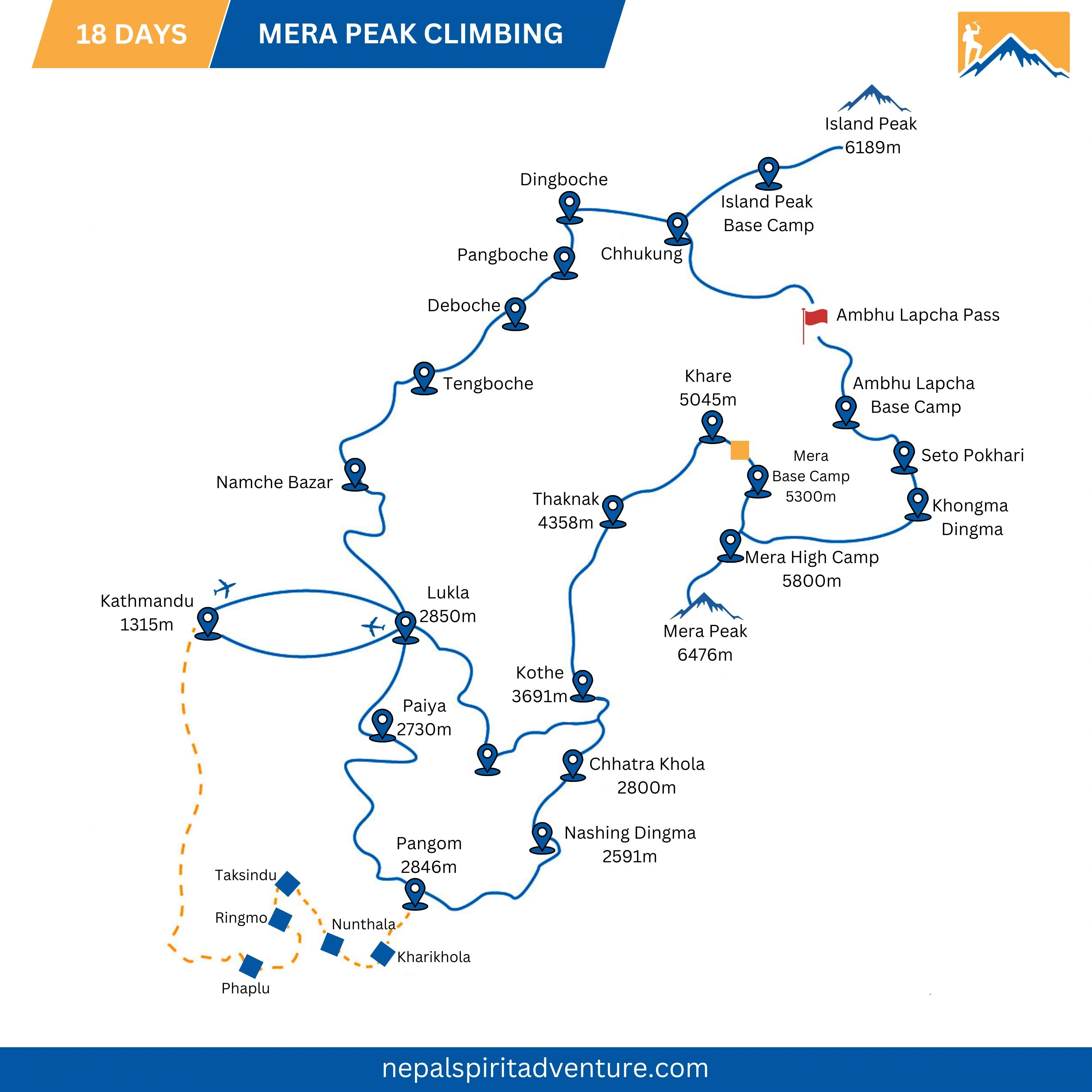
The classic Mera Peak Expedition route begins with a scenic flight from Kathmandu to Lukla, the gateway to the Everest region. From Lukla, the trek follows a less-traveled trail through remote valleys, traditional Sherpa villages, and beautiful Himalayan landscapes before reaching the Mera Peak climbing area.
\r\n\r\n
The popular trekking route passes through several picturesque settlements, including Paiya, Pangkongma, Nashing Dingma, Chalem Kharka, and Kothe, before continuing toward Tangnang (Thaknak) and Khare, the main acclimatization and preparation point for the climb.
\r\n\r\n
From Khare, climbers continue toward Mera Base Camp and cross the Mera La Pass before reaching Mera High Camp. The final summit push involves glacier travel on snow and ice using basic mountaineering equipment such as crampons, an ice axe, and ropes. After reaching the summit of Mera Peak (6,476 m / 21,247 ft), climbers enjoy spectacular panoramic views of some of the world's highest mountains before descending back to Lukla and flying to Kathmandu.
\r\n\r\n
The Mera Peak route combines remote wilderness trekking, authentic Sherpa culture, and an exciting Himalayan climbing experience, making it one of Nepal’s most rewarding trekking peak adventures.
"}},{"@type":"Question","name":"What are the risks involved in the Mera Peak Climb?","acceptedAnswer":{"@type":"Answer","text":"
Like any high-altitude Himalayan adventure, the Mera Peak Climb involves certain risks that should be carefully managed through proper preparation, responsible planning, and professional guidance. The major challenges include altitude sickness (Acute Mountain Sickness/AMS), extreme weather conditions, glacier travel, falls, and possible avalanches.
\r\n\r\n
The high elevation of Mera Peak (6,476 m / 21,247 ft) means climbers may experience altitude-related symptoms due to lower oxygen levels. Proper acclimatization, a gradual ascent, adequate hydration, and following the advice of experienced guides are essential to reduce the risk of altitude sickness.
\r\n\r\n
Weather in the Himalayas can change rapidly, bringing cold temperatures, heavy snowfall, strong winds, and reduced visibility. The use of appropriate clothing, quality climbing equipment, and flexible scheduling helps manage these mountain conditions safely.
\r\n\r\n
During the summit climb, participants may encounter glacier terrain requiring the use of technical equipment such as crampons, an ice axe, harnesses, and ropes. Our experienced Sherpa climbing guides provide safety instructions and support throughout the climbing section.
\r\n\r\n
For a safe and successful Mera Peak Expedition, we strongly recommend purchasing comprehensive travel insurance that covers high-altitude trekking, peak climbing, emergency evacuation, and medical expenses. With proper preparation, experienced guides, and careful risk management, Mera Peak can be an achievable and rewarding Himalayan adventure.
"}},{"@type":"Question","name":"How fit do I need to be for the Mera Peak Climbing?","acceptedAnswer":{"@type":"Answer","text":"
The Mera Peak Climbing requires a good level of physical fitness, endurance, and mental preparation due to the long trekking days, high altitude, and challenging Himalayan conditions. Although Mera Peak is considered a non-technical trekking peak, reaching the summit at 6,476 meters (21,247 feet) demands proper preparation and commitment.
\r\n\r\n
You should be comfortable walking for 5 to 7 hours per day on varied mountain terrain while carrying a light daypack. Good cardiovascular fitness, leg strength, stamina, and the ability to walk continuously for several days are essential for a successful climb.
\r\n\r\n
Previous trekking or mountaineering experience is helpful but not compulsory. With regular training, proper acclimatization, and guidance from experienced Sherpa climbing guides, fit trekkers with a strong determination and positive attitude can successfully attempt the Mera Peak summit.
\r\n\r\n
We recommend starting your preparation several months before the expedition with activities such as hiking,jogging,cycling,swimming, stair climbing, and strength training. Building your endurance and improving your overall fitness will make your Mera Peak Climbing experience safer, more enjoyable, and more rewarding.
"}},{"@type":"Question","name":"Can I climb Mera Peak independently?","acceptedAnswer":{"@type":"Answer","text":"
Although it may be possible for experienced mountaineers to attempt Mera Peak independently, climbing without professional support is not recommended due to the high altitude, glacier conditions, changing weather, and remote Himalayan environment.
\r\n\r\n
A successful Mera Peak Climbing expedition requires proper acclimatization, knowledge of high-altitude trekking, basic mountaineering skills, and the ability to use technical equipment such as crampons, an ice axe, harnesses, and ropes. Hiring an experienced climbing guide provides essential safety support, route knowledge, and assistance during the summit attempt.
\r\n\r\n
For most climbers, especially those unfamiliar with Nepal’s high-altitude conditions, it is strongly recommended to join a registered trekking agency with a qualified Sherpa climbing guide. A professional team will help manage permits, logistics, accommodation, equipment, safety procedures, and emergencies, allowing you to focus on enjoying the incredible Himalayan experience.
\r\n\r\n
With the support of an experienced guide and proper preparation, the Mera Peak Expedition becomes a safer and more enjoyable adventure.
"}},{"@type":"Question","name":"What is the altitude sickness risk during Mera Peak Climbing?","acceptedAnswer":{"@type":"Answer","text":"
Altitude sickness (Acute Mountain Sickness or AMS) is one of the main challenges during the Mera Peak Climbing expedition because the route reaches a high elevation of 6,476 meters (21,247 feet). As altitude increases, the oxygen level decreases, and some climbers may experience difficulty adapting to the thinner air.
\r\n\r\n
Common symptoms of altitude sickness include headache, nausea, dizziness, fatigue, loss of appetite, difficulty sleeping, and shortness of breath. In rare but serious cases, altitude-related illnesses can become life-threatening if not treated properly.
\r\n\r\n
To reduce the risk of AMS, our Mera Peak itinerary is carefully designed with gradual altitude gain and sufficient acclimatization time. Our experienced trekking and Sherpa climbing guides monitor your health throughout the journey, maintain a safe pace, and provide guidance on hydration, rest, and proper acclimatization.
\r\n\r\n
It is important to inform your guide immediately if you experience any symptoms of altitude sickness. If symptoms become severe or continue to worsen, descending to a lower altitude is the most effective treatment.
\r\n\r\n
With proper preparation, a gradual ascent, experienced guides, and responsible trekking practices, most properly prepared climbers can complete the Mera Peak Expedition safely and successfully.
"}}]}
18
Days
Mera Peak Climbing
151 Reviews in TripAdvisor
38 Reviews in Google Reviews
Mera Peak Climbing takes you through the remote Inkhu Valley in the southeastern Khumbu (Everest) region, one of the least-visited trekking areas in Nepal. This remarkable journey offers an authentic wilderness experience, far from the crowded trekking routes.
Along the way, you'll discover spectacular mountain landscapes, deep valleys, pristine forests of fir and rhododendron, impressive glaciers, and vast icefields, all surrounded by some of the world's highest peaks. The adventure also provides a unique opportunity to visit traditional Sherpa villages, where you can experience the rich culture and warm hospitality of the local communities in this less-traveled part of the Everest region.
Duration
18 Days
Trip Grade
Strenuous
The strenuous grade is both moderate and difficult. Even in this grade, treks reach around 5,000-5,500 meters. You walk generally 6-7 hours every day. Strenuous treks require good physical condition and acclimatization. if some problems appear, you have to walk down and take some hot drinks or soup. You may get affected fast if you have high blood pressure, asthma, heart disease, or complicated medical conditions.
Country
Nepal
Maximum Altitude
6,476m | 21,247ft
Group Size
2 - 10 People in Group
Starts
Kathmandu
Ends
Kathmandu
Activities
Peak Climbing in Nepal
Best Time
March - May | Sep - Dec
Trip Highlights
Enjoy a spectacular mountain flight to and from Lukla, the gateway to the Everest region.
Experience the unique lifestyle, culture, and warm hospitality of the Sherpa people in the heart of the Himalayas.
Take in breathtaking views of Kangchenjunga, Makalu, Everest, Lhotse, Nuptse, Ama Dablam, Cho Oyu, and many other Himalayan peaks.
Stay in traditional teahouses while exploring the remote and unspoiled regions of the Everest area.
Summit Mera Peak (6,476 m / 21,247 ft), Nepal's highest trekking peak, and enjoy unforgettable panoramic views of the world's highest mountains.
Trip Overview
Mera Peak Climbing is one of Nepal's most rewarding high-altitude adventures, offering the opportunity to summit Mera Peak (6,476 m / 21,247 ft), the highest trekking peak in Nepal. Located in the spectacular Khumbu(Everest) Region within the Mahalangur Himalayan Range, Mera Peak combines breathtaking mountain scenery, authentic Sherpa culture, and an unforgettable Himalayan climbing experience.
Despite its impressive elevation, Mera Peak is considered a non-technical trekking peak, making it an excellent choice for adventurous trekkers with good physical fitness. Previous mountaineering experience is helpful but not essential. With proper acclimatization, basic climbing instruction, and guidance from experienced Sherpa climbing guides, many first-time climbers successfully reach the summit.
The journey begins with a scenic mountain flight from Kathmandu to Lukla, the gateway to the Everest region. From Lukla, the trail follows a quieter route through the remote and pristine Inkhu Valley, passing dense forests of rhododendron and fir, traditional Sherpa villages, alpine meadows, glacial valleys, and high mountain passes before reaching Khare and Mera Base Camp. After summiting Mera Peak, the trek follows a direct route back to Lukla for the return flight to Kathmandu.
Mera Peak Climbing is both a trekking and mountaineering adventure that takes you into the heart of the Himalayas. Climbers should be physically fit and prepared for high-altitude conditions. Basic skills in using crampons, an ice axe, a climbing harness, and a fixed rope are recommended. If needed, our experienced climbing guides provide practical training at Mera Base Camp before the summit ascent, ensuring that all participants are well prepared and confident.
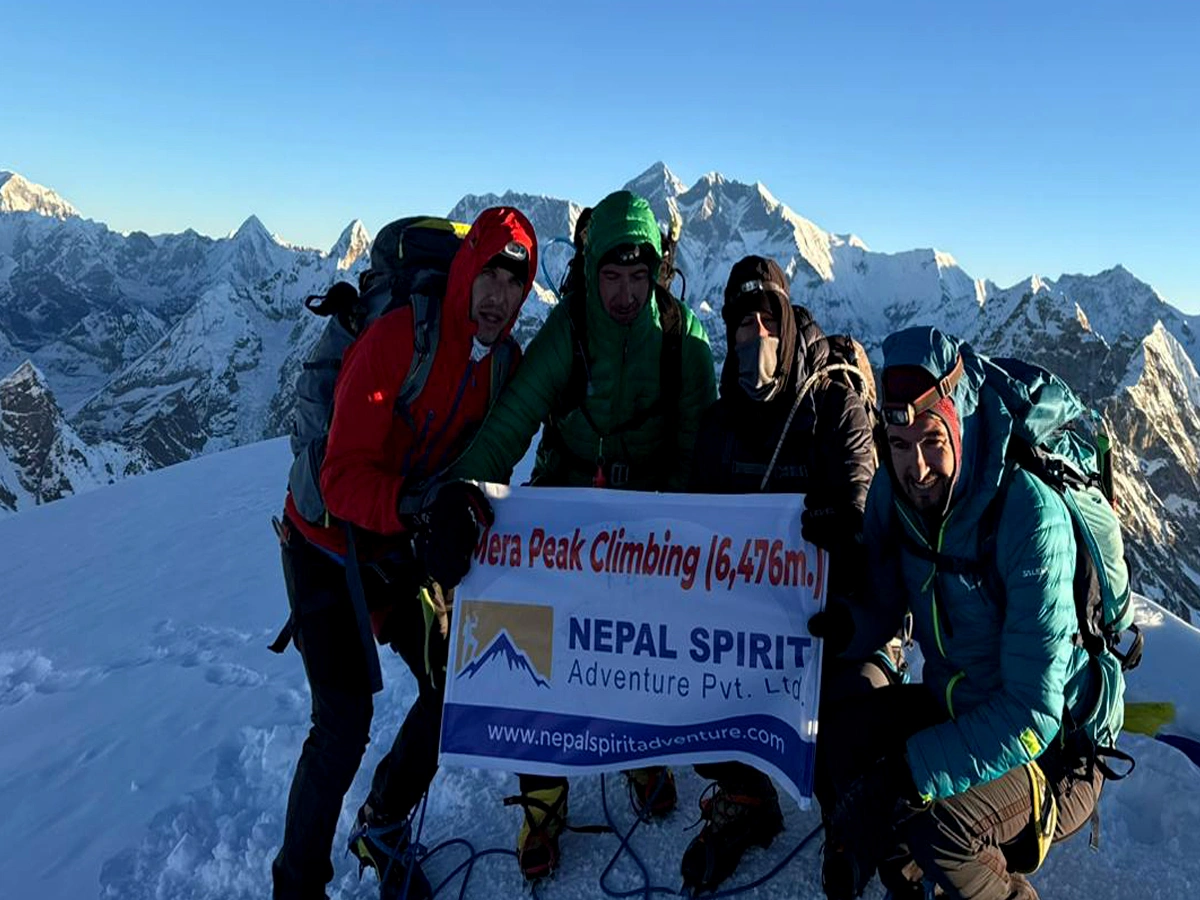
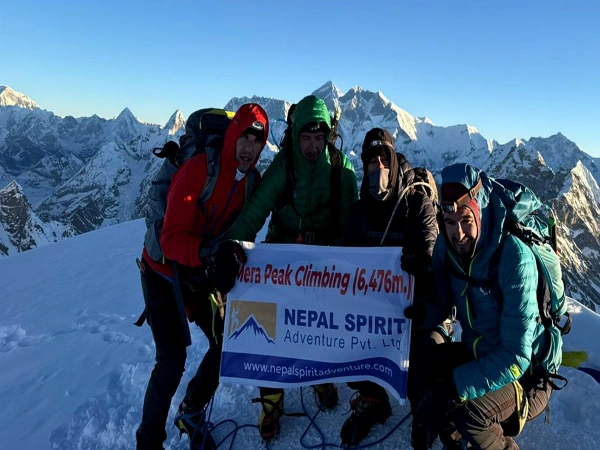
On a clear day, the summit of Mera Peak rewards climbers with one of the most spectacular panoramic views in the Himalayas. From the top, you can admire five of the world's highest mountains—Mount Everest (8,848.86 m), Lhotse (8,516 m), Makalu (8,485 m), Cho Oyu (8,188 m), and Kangchenjunga (8,586 m)—along with the magnificent peaks of Nuptse, Ama Dablam, Kangtega, Chamlang, Baruntse, and many other snow-covered giants. Few trekking peaks in Nepal offer such an extraordinary mountain panorama.
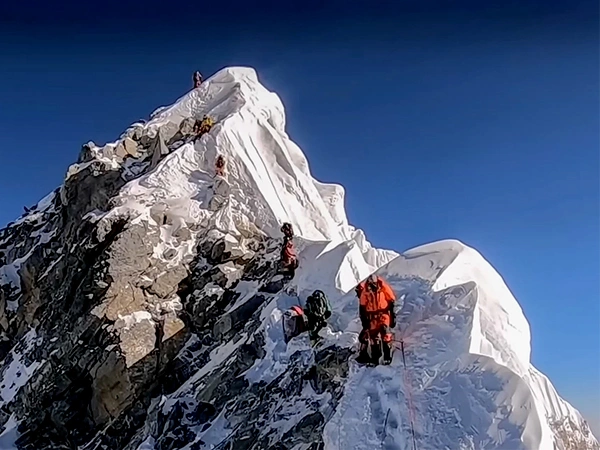
The summit climb follows the gradual slopes of the Mera Glacier before ascending the spectacular summit ridge. Although the final section is exposed, it is straightforward under normal weather conditions and offers an exhilarating finish to this remarkable Himalayan ascent. After celebrating your achievement, you descend safely to Khare before retracing the trail to Lukla and flying back to Kathmandu.
As with any Himalayan expedition, weather conditions are unpredictable and can change rapidly. To maximize your chances of reaching the summit safely, this itinerary includes an additional contingency day. If poor weather prevents the summit attempt on the planned day, the spare day provides another opportunity to climb Mera Peak.
If the weather remains favorable and the contingency day is not required, you can use it to relax and enjoy the vibrant mountain town of Lukla. Lukla offers comfortable teahouses, cafés, bakeries, restaurants, and bars, making it the perfect place to celebrate the successful completion of your Mera Peak Climbing adventure before returning to Kathmandu.
Preparation for Mera Peak Expedition
Proper preparation is the key to a successful Mera Peak Expedition. As one of Nepal’s most popular high-altitude trekking peaks, Mera Peak (6,470 m / 21,227 ft) requires good physical fitness, basic mountaineering skills, mental strength, and the right equipment. Before beginning your Mera Peak Climbing adventure, consider the following essential preparation guidelines.
Physical Fitness and Endurance
Mera Peak Climbing is a physically demanding Himalayan adventure that involves long trekking days, steep ascents, and walking at high altitudes. Building your strength, stamina, and cardiovascular fitness before the expedition is highly recommended. Regular training activities such as hiking, jogging, cycling, swimming, stair climbing, and strength exercises will help prepare your body for the challenges ahead.
Technical Climbing Skills
Although Mera Peak is considered a non-technical trekking peak, climbers must have basic mountaineering knowledge and confidence in using climbing equipment. Skills such as using an ice axe and crampons, rope techniques, glacier travel, and basic climbing safety are essential for the summit ascent.
If you have limited or no previous climbing experience, completing a basic mountaineering course before the expedition is strongly recommended. Practicing climbing skills on local hills, mountains, or glaciers will increase your confidence and improve your overall safety during the climb.
Acclimatization and Altitude Preparation
Acclimatization is one of the most important factors for a successful Mera Peak Expedition. The journey takes you above 6,000 meters, where oxygen levels are significantly lower. A well-planned itinerary with gradual altitude gain allows your body to adapt and reduces the risk of altitude-related problems.
Spending sufficient time at high elevations, staying hydrated, maintaining a steady pace, and following your guide’s advice are essential for safe acclimatization. Some climbers also discuss altitude medication such as Diamox with their doctor before traveling.
Climbing Equipment and Clothing
Having the proper equipment is essential for a safe and comfortable Mera Peak Climbing experience. Essential mountaineering gear includes an ice axe, crampons, a climbing harness, a helmet, carabiners, ropes, and suitable technical clothing.
You should also prepare for extreme Himalayan weather conditions by bringing warm and waterproof clothing, including a down jacket, insulated layers, Gore-Tex outerwear, gloves, and quality trekking boots. Weather conditions in the mountains can change quickly, so carrying extra layers and essential gear is always recommended.
Nutrition and Hydration
Maintaining a balanced diet helps you stay energized throughout the trek and climb. Your meals should include a good balance of carbohydrates, proteins, and healthy fats to support endurance and recovery.
High-energy snacks such as chocolate, energy bars, nuts, and dried fruits are useful during long trekking days and summit preparation. Staying properly hydrated is equally important, especially at high altitudes.
Mental Preparation and Teamwork
Mera Peak Expedition is not only a physical challenge but also a mental journey. Climbers should be prepared for long trekking days, changing weather conditions, cold temperatures, and the challenges of high-altitude environments.
A positive mindset, patience, adaptability, and good teamwork are important qualities for a successful summit experience. Working closely with your climbing guides and team members will help you overcome challenges and make your Mera Peak adventure a safe and memorable achievement.
''Customized trek and climbing itineraries are available as per your travel holiday needs.''
Fly to Lukla – Trek to Paiya (2,730 m) 5-6hrs walk
Max. Altitude
2,730m
Day 04
Trek from Paiya to Pangom Village (2945 m) 5-6hrs walk
Max. Altitude
2,945m
Day 05
Trek from Pangom to Nashing Dingma (2,600 m) 6hrs walk
Max. Altitude
2,600m
Day 06
Trek from Nashin Dingma to Chhatra Khola (2,800 m) 7hrs trek
Max. Altitude
2,800m
Day 07
Trek from Chhatra Khola to Kothe (3,600 m) 6hr
Max. Altitude
3,600m
Day 08
Trek from Kothe to Thaknak (4,358 m) 4hrs walking
Max. Altitude
4,358m
Day 09
Trek from Thaknak to Khare (5,045 m) 3hrs Walk
Max. Altitude
5,045m
Day 10
Acclimatization & Pre Climb Training
Max. Altitude
5,045m
Day 11
Trek from Khare to Mera High Camp (5,800 m) 6hrs
Max. Altitude
5,800m
Day 12
Summit Mera Peak (6,476 m) – Return to Khare 10hrs
Max. Altitude
6,476m
Day 13
Contingency Day for Summit Attempt (Bad Weather Reserve)
Max. Altitude
5,044m
Day 14
Trek from Khare to Kothe (3,600 m) 5hrs walk
Max. Altitude
3,691m
Day 15
Trek from Kothe to Thuli Kharka (4,300 m) 6hrs walk
Max. Altitude
4,300m
Day 16
Trek from Thuli Kharka to Lukla via Zatrwa La Pass (4,610 m) 7hrs
Max. Altitude
4,610m
Day 17
Fly to Kathmandu or Manthali (Ramechhap)
Max. Altitude
1,324m
Day 18
Departure – End of the Trip
Max. Altitude
1,324m
Mera Peak Climbing Itinerary
Customize Mera Peak Climbing itinerary is available as per your Nepal holiday. Furthermore, information contacts us at any time for the best cost and service of Mera Peak Climbing 2026.
Start Point:Kathmandu
End Point:Kathmandu
Day01
Arrival at Kathmandu Airport – Transfer to Hotel
Upon your arrival at Tribhuvan International Airport in Kathmandu, Nepal, you will be warmly welcomed by a representative from Nepal Spirit Adventure. You will then be transferred to your hotel in Thamel, Kathmandu's vibrant tourist district.
After checking in and enjoying some refreshments, you can relax at the hotel or take a stroll through the lively streets of Thamel, where you'll find a variety of shops, restaurants, cafés, and local markets. Depending on your arrival time, you may have the opportunity to explore the area and experience the vibrant atmosphere before your adventure begins.
Overnight: Hotel in Kathmandu (Hotel Jampa or similar)
Max. Altitude: 1,324m (4,343ft)Accommodation: HotelMode of Transportation: Private Vehicle
Day02
Trip Preparation – Overnight at Hotel
Breakfast is included in your tour package and is typically served between 7:00 AM and 10:00 AM, depending on your hotel's schedule.
Today is a preparation and briefing day before your adventure begins. You will meet your trekking and climbing guide, who will provide a detailed briefing about the Mera Peak Climbing 2026 expedition. During the briefing, you will review the itinerary, check your trekking and climbing equipment, and ensure that everything is ready for the journey ahead. This is also an excellent opportunity to ask any questions about the trek, climbing procedures, safety, or logistics.
After the briefing, you are free to relax at the hotel or spend the rest of the day at your leisure.
If you would like to explore Kathmandu's rich cultural and historical heritage, you may join an optional guided sightseeing tour (available at an additional cost). Please speak with our tour manager or book the tour in advance.
Popular sightseeing attractions include:
Swayambhunath (Monkey Temple)
Kathmandu Durbar Square
Boudhanath Stupa
Pashupatinath Temple
Overnight: Hotel in Kathmandu (Hotel Jampa or Similar)
Max. Altitude: 1,324m (4,343ft)Meals: BreakfastAccommodation: Hotel
Day03
Fly to Lukla – Trek to Paiya (2,730 m) 5-6hrs walk
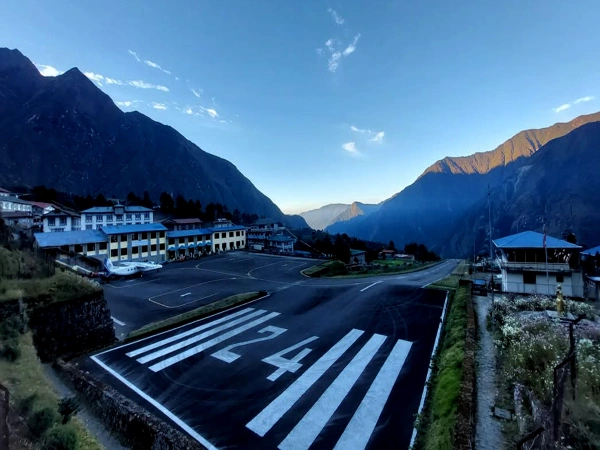
Early in the morning, you will be transferred to Kathmandu's domestic airport for a spectacular 35-minute flight to Lukla, one of the world's most famous mountain airports. During the flight, enjoy breathtaking views of the Himalayan peaks and the beautiful landscapes below.
Upon arrival at Lukla, you will meet the rest of the Nepal Spirit Adventure trekking crew, including your porters and support staff. After a short break to refresh and prepare, your trek begins.
Leaving Lukla, you descend past the airport runway and follow the trail to the village of Surkhe. From Surkhe, the trail gradually ascends through peaceful forests and along a pleasant winding path, offering beautiful views of the surrounding hills and traditional Sherpa villages.
After several hours of trekking, you will arrive at Paiya (also known as Chutok), a charming mountain village surrounded by lush forests. This is your first overnight stop on the Mera Peak adventure.
Overnight: Teahouse in Paiya (Chutok).
Leaving Lukla, you descend past the airport runway and follow the trail to the village of Surkhe. From Surkhe, the trail gradually ascends through peaceful forests and along a pleasant winding path, offering beautiful views of the surrounding hills and traditional Sherpa villages.
After several hours of trekking, you will arrive at Paiya (also known as Chutok), a charming mountain village surrounded by lush forests. This is your first overnight stop on the Mera Peak adventure.
Overnight: Teahouse in Paiya (Chutok).
Max. Altitude: 2,730m (8,956ft)Meals: Breakfast, Lunch and Dinner includedAccommodation: Guesthouse
Day04
Trek from Paiya to Pangom Village (2945 m) 5-6hrs walk
After breakfast, we begin today's trek by descending through a forested trail to a small bridge. From here, the path gradually ascends toward Kari La Pass, where some sections can be steep and slippery, especially after rain.
The trail winds through beautiful rhododendron and bamboo forests, following a narrow mountain path with impressive views of the surrounding hills and the picturesque Dudhkoshi Valley. Along the way, you'll enjoy the peaceful natural surroundings and experience the quieter trails of the Hinku Valley region.
After crossing Kari La Pass, we continue our descent before making a final gradual climb to Pangom Village, a traditional Sherpa settlement where the local people primarily depend on farming and trade for their livelihood.
Overnight: Teahouse in Pangom Village. Walking Hours: Approximately 5-6 hours of trekking.
Max. Altitude: 2,945m (9,662ft)Meals: Breakfast, Lunch and Dinner includedAccommodation: Tea House
Day05
Trek from Pangom to Nashing Dingma (2,600 m) 6hrs walk
After breakfast, we leave the main trekking route of the lower Solu region and head north into the remote and beautiful Hinku Valley. The morning trail passes through dense alpine forests, offering a peaceful walk with occasional views of seasonal herders' shelters near Cherem.
From Pangom, we begin a steady climb along a winding trail to Pangom La Pass (3,170 m / 10,400 ft). From the pass, enjoy magnificent views of the surrounding Himalayan peaks, including the impressive south face of Mera Peak.
From Pangom La, the trail descends steeply toward the Hinku Khola, following a scenic ridgeline for much of the journey. After reaching the valley floor, we cross a suspension bridge over the river and begin a final two-hour ascent through a beautiful forest.
By late afternoon, we arrive at the small settlement of Nashing Dingma, where we spend the night surrounded by the peaceful wilderness of the Hinku Valley.
Overnight: Teahouse in Nashing Dingma.
Max. Altitude: 2,600m (8,530ft)Meals: Breakfast, Lunch and DinnerAccommodation: Guesthouse
Day06
Trek from Nashin Dingma to Chhatra Khola (2,800 m) 7hrs trek
After breakfast, we begin the day with a series of gradual ascents and descents as we make our way to Ramailo Danda. From this scenic ridge, we are rewarded with spectacular views of Mera Peak, Salpa, and the surrounding Himalayan landscape.
Continuing along the trail, we officially enter the Makalu Barun National Park, a protected area renowned for its rich biodiversity and pristine mountain wilderness. From here, we follow the historic Pasang Lhamu Trail, which leads us through dense forests, peaceful valleys, and beautiful alpine scenery.
The forests in this region are home to a variety of wildlife. If we are fortunate, we may even spot the rare and elusive Red Panda along the way.
By late afternoon, we arrive at Chhatra Khola, a small settlement nestled beside the river, where we will spend the night.
Overnight: Teahouse in Chhatra Khola.
Max. Altitude: 2,800m (9,186ft)Meals: Breakfast, Lunch, and Dinner includedAccommodation: Tea House
Day07
Trek from Chhatra Khola to Kothe (3,600 m) 6hr
After breakfast, we continue our journey into the beautiful Hinku Valley. Today's trek is relatively easier, following a well-defined trail through peaceful forests and alongside the Hinku Khola.
The day begins with a short climb of about 30 minutes before the trail descends gradually, becoming steeper as it reaches the floor of the V-shaped Hinku Valley, carved by the glacial waters of the Hinku Khola.
As we continue, the landscape changes from rocky hillsides to lush forests of pine, rhododendron, and juniper. The trail follows the right bank of the river, gradually ascending through the valley while offering beautiful views of the surrounding wilderness.
Just before reaching Kothe, we cross the fast-flowing Hinku Khola via a wooden bridge. There are no permanent settlements along today's route, making this one of the most peaceful sections of the trek.
We arrive at Kothe, a small riverside settlement that serves as an important stop for trekkers and climbers heading toward Mera Peak.
Overnight: Teahouse in Kothe.
Max. Altitude: 3,600m (11,811ft)Duration: 6 - 7 hours trekMeals: Breakfast, Lunch and Dinner includedAccommodation: Tea House
Day08
Trek from Kothe to Thaknak (4,358 m) 4hrs walking
After breakfast, we continue our trek along the banks of the Hinku Khola, following the valley beneath the towering slopes of Mera Peak. As we gain altitude, the landscape becomes increasingly alpine, with breathtaking views of the surrounding snow-capped mountains.
Around midday, we stop for lunch at Gondishung, a traditional summer grazing settlement used by local yak herders, situated on the west bank of the Hinku Drangka.
After lunch, we visit the historic Lungsumgba Gompa, a small monastery believed to be over 200 years old. Here, you can see a rock carving that depicts Mera Peak and the traditional climbing route, adding a unique cultural and historical element to the journey.
A short and gentle walk from the monastery brings us to Thaknak, a seasonal grazing settlement with a few teahouses and basic shops serving trekkers and climbers. The afternoon is a good opportunity to rest and acclimatize as we prepare for higher elevations.
After breakfast, we leave Thaknak and follow the lateral moraine of the Dig Glacier toward Dig Kharka, enjoying spectacular views of Charpate Himal and the surrounding Himalayan peaks.
The trail gradually ascends over glacial moraines, passing the snouts of the Hinku Nup Glacier and Shar Glacier. As we gain altitude, the landscape becomes more rugged and dramatic, with towering ice formations and expansive mountain vistas.
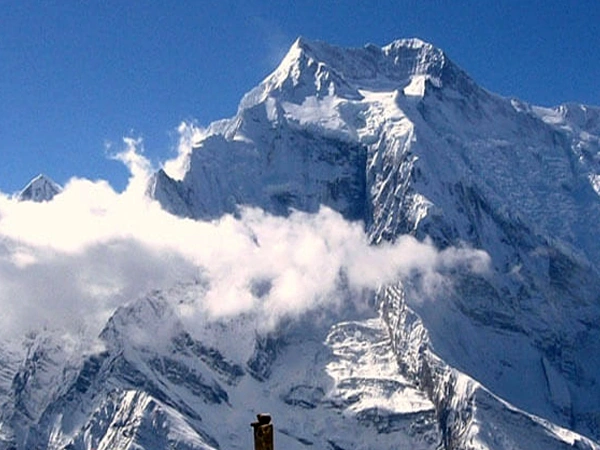
A steeper climb brings us to Khare, the final permanent settlement before Mera Peak Base Camp. From here, we are rewarded with breathtaking views of the impressive north face of Mera Peak, providing an exciting glimpse of the mountain we will soon attempt to climb.
After lunch, there is time to relax or explore the surrounding area to aid acclimatization. Your climbing guide will also check your equipment and prepare you for the upcoming climbing days.
Today is dedicated to acclimatization and pre-climb training, giving your body time to adjust to the high altitude while preparing for the ascent of Mera Peak.
After breakfast, your experienced climbing guide will conduct a practical training session covering the essential skills and techniques needed for the climb. You will learn and practice the proper use of climbing equipment, including the ice axe, harness, crampons, mountaineering boots, helmet, ascender (jumar), and carabiners.
The training will also include walking with crampons, using fixed ropes, ascending with a jumar, descending safely, and other basic mountaineering techniques. This session is designed to build your confidence and ensure that you are comfortable using your equipment before the summit attempt.
The remainder of the day can be spent resting, hydrating, and enjoying the spectacular mountain scenery, all of which are important for successful acclimatization.
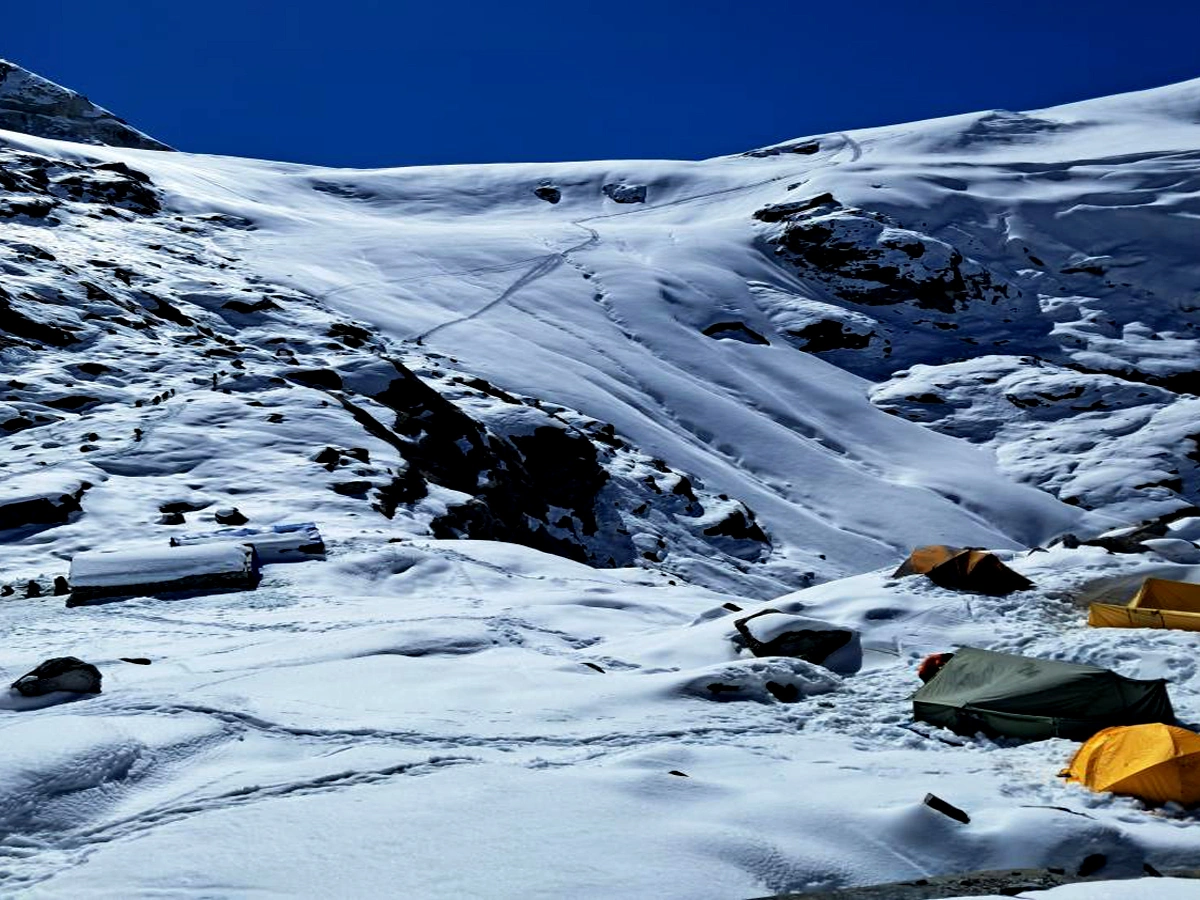
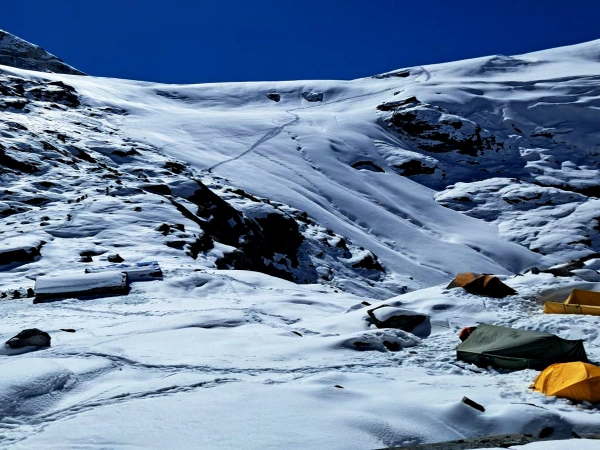
After breakfast, we begin our ascent from Khare toward Mera High Camp. The trail follows the Mera Glacier, where we travel across snowfields using crampons and other climbing equipment under the guidance of our experienced climbing leader.
As we progress across the glacier, we gradually climb toward Mera La Pass, where the slope becomes steeper and the scenery more dramatic. This is one of the most spectacular sections of the entire expedition, surrounded by some of the highest mountains in the world.
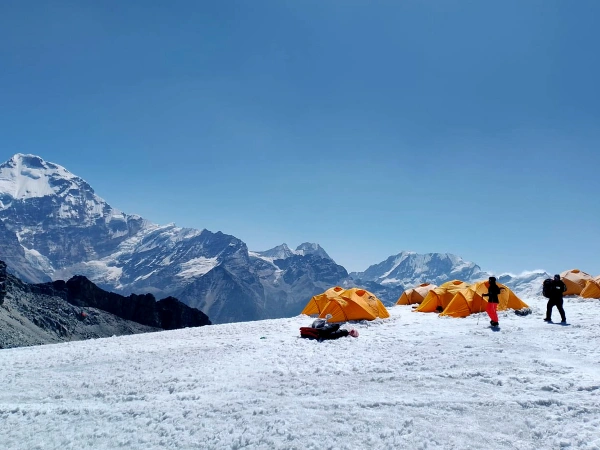
From High Camp, you will be rewarded with breathtaking panoramic views of the Himalayas. To the east rise Chamlang (7,290 m / 23,917 ft),Makalu (8,485 m / 27,838 ft), and Baruntse (7,129 m / 23,389 ft). To the north, the magnificent peaks of Everest (8,848.86 m / 29,031 ft),Lhotse (8,516 m / 27,940 ft), and Nuptse (7,861 m / 25,791 ft) dominate the skyline. Looking west, you can admire the elegant silhouette of Ama Dablam, the massive Cho Oyu (8,188 m / 26,864 ft), and the striking peak of Kangtega.
After settling into Mera High Camp, your guide will review the summit plan and make final preparations for the early morning climb. Enjoy an early dinner and get plenty of rest before the summit attempt.
Overnight: Mera High Camp.
From High Camp, you will be rewarded with breathtaking panoramic views of the Himalayas. To the east rise Chamlang (7,290 m / 23,917 ft), Makalu (8,485 m / 27,838 ft), and Baruntse (7,129 m / 23,389 ft). To the north, the magnificent peaks of Everest (8,848.86 m / 29,031 ft), Lhotse (8,516 m / 27,940 ft), and Nuptse (7,861 m / 25,791 ft) dominate the skyline. Looking west, you can admire the elegant silhouette of Ama Dablam, the massive Cho Oyu (8,188 m / 26,864 ft), and the striking peak of Kangtega.
After settling into Mera High Camp, your guide will review the summit plan and make final preparations for the early morning climb. Enjoy an early dinner and get plenty of rest before the summit attempt.
Overnight: Mera High Camp.
Max. Altitude: 5,800m (19,028ft)Meals: Breakfast, Lunch and Dinner includedAccommodation: Tent
Day12
Summit Mera Peak (6,476 m) – Return to Khare 10hrs
Today is the highlight of our expedition as we attempt to summit Mera Peak (6,476 m / 21,247 ft). We begin the day very early, waking at around 2:00 AM for breakfast before setting off under the stars.
The morning temperatures are extremely cold, but as we steadily ascend the glacier, our bodies warm up with the climb. Following the guidance of our climbing leader, we make our way across the glacier and onto the broad summit ridge. As dawn breaks, the first rays of sunlight illuminate the Himalayan giants, creating a spectacular display of golden and crimson colors across the snow-covered peaks.
The route is mostly non-technical, although the high altitude makes the climb physically demanding. Near the summit, the final snow slope becomes steeper. Depending on snow and ice conditions, your climbing leader may fix a safety rope to assist the final ascent.
Reaching the summit of Mera Peak is a truly unforgettable achievement. From the top, you will enjoy one of the finest panoramic mountain views in the Himalayas, including Everest (8,848.86 m), Lhotse (8,516 m), Makalu (8,485 m), Cho Oyu (8,188 m), Kanchenjunga (8,586 m), Nuptse (7,861 m), Chamlang (7,290 m), and Baruntse (7,129 m).
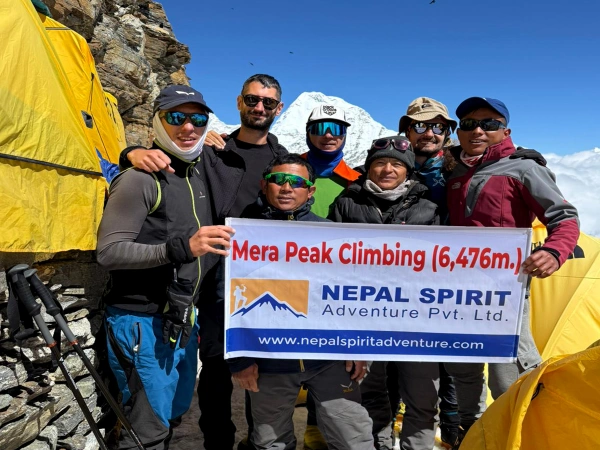
After celebrating your successful ascent and capturing photographs from the summit, we carefully descend to Mera High Camp for a short rest and refreshments before continuing down to Khare.
Overnight: Teahouse in Khare.
Max. Altitude: 6,476m (21,246ft)Meals: Breakfast, Lunch and Dinner includedAccommodation: Guesthouse
Day13
Contingency Day for Summit Attempt (Bad Weather Reserve)
Today is reserved as a contingency day in case unfavorable weather or unforeseen conditions prevent us from attempting the summit of Mera Peak on the scheduled day.
High-altitude mountaineering is highly dependent on weather, trail conditions, and the health and safety of the climbing team. This extra day provides valuable flexibility, allowing us to wait for improved conditions and maximize the chances of a safe and successful summit.
If the summit is completed as planned on Day 12, this contingency day will not be required, and we will continue with the itinerary as scheduled.
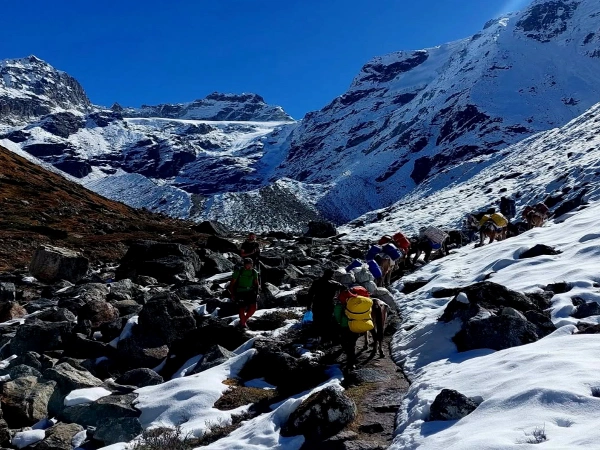
After an unforgettable Mera Peak climbing adventure, we begin our descent toward Kothe. Leaving the high alpine landscape behind, the trail retraces our route through glacial valleys and rugged mountain terrain.
Since we are descending, the trek is much more comfortable, with no concerns about altitude gain. Although the trail includes a few gentle ascents and descents, the overall journey is easier as we gradually return to lower elevations.
As we lose altitude, the barren alpine scenery gives way to lush forests, green vegetation, and the peaceful surroundings of the Hinku Valley. By late afternoon, we arrive at Kothe, a small riverside settlement traditionally used by yak herders and trekkers.
The rest of the day is free to relax and celebrate the successful completion of your Mera Peak expedition.
Trek from Kothe to Thuli Kharka (4,300 m) 6hrs walk
After breakfast, we leave Kothe and take a different route back toward Lukla. We begin our journey by following the trail southward along the left side of the Hinku Khola, enjoying a peaceful walk through the beautiful valley.
After a few hours of gradual descent, we start ascending westward toward Thuli Kharka. The trail climbs steadily through dense forests, offering beautiful views of the surrounding hills and the natural wilderness of the region.
Along the way, we stop for lunch at Toktar, a small settlement surrounded by forest. After a short rest, we continue our climb through the woodland area, crossing some rocky sections before reaching the final part of the trail.
The route then gradually descends toward Thuli Kharka, a quiet mountain settlement where we will spend the night.
Trek from Thuli Kharka to Lukla via Zatrwa La Pass (4,610 m) 7hrs
After breakfast, we begin our final trekking day toward Lukla. The trail takes us across the challenging yet rewarding Zatrwa La Pass (4,600 m / 15,092 ft), the highest point on this section of the route.
From Thuli Kharka, we ascend gradually toward the pass, where we are rewarded with magnificent views of the surrounding Himalayan peaks and valleys. After taking time to enjoy the scenery and capture memorable photographs, we begin our descent toward the Hinku Valley and eventually reconnect with the trail leading to Lukla.
The path continues through beautiful landscapes of forests, hillsides, and traditional Sherpa settlements. As we approach Lukla, the familiar mountain scenery and warmer surroundings mark the completion of our incredible Mera Peak Climbing expedition.
Upon arrival in Lukla, we celebrate the successful completion of our trek and enjoy a well-deserved rest at the lodge.
Overnight: Hotel in Lukla
Max. Altitude: 4,610m (15,124ft)Meals: Breakfast, Lunch & DinnerAccommodation: Hotel
Day17
Fly to Kathmandu or Manthali (Ramechhap)
Day 17: Fly to Kathmandu or Manthali (Ramechhap)
After breakfast, we take a scenic flight from Lukla back to either Kathmandu or Manthali (Ramechhap), depending on the season and flight operations.
Flight to Manthali (Ramechhap) During the peak trekking seasons (March to May and October to November), flights between Lukla and Manthali Airport operate regularly. The flight takes approximately 25 minutes. Upon arrival at Manthali Airport, you will continue your journey to Kathmandu by a shared tourist vehicle, which takes around 4–6 hours depending on road and traffic conditions. Upon reaching Kathmandu, you will be transferred to your hotel.
Flight to Kathmandu During the off-season months, flights usually operate directly between Lukla and Kathmandu. The scenic mountain flight takes approximately 35 minutes. After landing at Kathmandu Airport, you will be transferred to your hotel by a shared tourist vehicle.
Optional Helicopter Flight to Kathmandu For a more comfortable and time-saving option, you can book a direct helicopter flight from Lukla to Kathmandu at an additional cost of USD 550 per person (based on sharing a helicopter with five passengers). This option is especially recommended during peak trekking seasons, when flights operate via Manthali and require a long overland drive to Kathmandu.
If you would like to extend your stay in Nepal, we can arrange additional travel experiences. Popular options include visiting Chitwan National Park for wildlife activities, exploring the beautiful lakeside city of Pokhara, or extending your journey to neighboring destinations such as Tibet or Bhutan.
Overnight: Hotel in Kathmandu.
Max. Altitude: 1,324m (4,343ft)Meals: BreakfastAccommodation: Hotel
Day18
Departure – End of the Trip
After an incredible journey and a memorable Mera Peak Climbing expedition with the excellent support and service of Nepal Spirit Adventure, your adventure in Nepal comes to an end today.
According to your international flight schedule, our representative will transfer you to Tribhuvan International Airport approximately 3 hours before your scheduled departure time. We will ensure a smooth and comfortable transfer, allowing you enough time for airport procedures and your onward journey home or to your next destination.
Thank you for choosing Nepal Spirit Adventure. We hope to welcome you again for another unforgettable Himalayan adventure.
Trip Ends.
Max. Altitude: 1,324m (4,343ft)Meals: BreakfastMode of Transportation: Airport drop by private vehicle
Still Confuse?
No worries — we’re here to help. Whether you have questions or just need a bit more clarity, feel free to reach out. Our team is ready to guide you every step of the way.
Three-night hotel in Kathmandu with breakfast (tourist standard hotel & prime location).
2 nights before the Mera Peak climb and 1 night after the Mera Peak trek.
NOTE:Includes a twin room in the trip package. Available private room, paying single, supplementary cost
Transportation
Private airport transfer from Kathmandu Tribhuvan International Airport to your hotel upon arrival.
Private transfer from your hotel to Kathmandu Tribhuvan International Airport on your final departure day.
Private transfers between your hotel and the domestic airport for both departure and arrival flights.
Round-trip domestic flights: Kathmandu–Lukla–Kathmandu or Ramechhap–Lukla–Ramechhap, depending on the flight schedule.
Tourist shared vehicle transfer between Kathmandu and Ramechhap (round trip), if Lukla flights operate from Ramechhap.
Trek Permit and Mera Climbing Permit
Mera Valley trekking route permit (Sagarmatha National Park Permit).
Mera Peak climbing permit.
Accommodation During the Mera Peak Trekking and Climbing Session
Lodge/ tea house during the trekking session.
Tent camp during the climbing period.
Food
We always provide hygienic meals during the trek and the Mera Peak climbing
3 meals a day (Breakfast, lunch, and dinner)
A cup of tea or coffee is provided at breakfast time.
Season fresh fruit
Mera Peak Climbing and Trekking Staff
Experienced Local Trekking Guide: Includes daily wages, salary, meals, accommodation, transportation, and insurance.
Experienced Sherpa Climbing Guide: Includes daily wages, salary, climbing equipment, meals, accommodation, transportation, and insurance.
Porter: One porter for every two trekkers, carrying a maximum load of 25 kg.
Assistant Trekking Guide: One assistant guide for every 10 trekkers, including daily wages, salary, meals, accommodation, transportation, and insurance.
Equipment
High-quality tents, kitchen utensils, along with the Mera peak climbing
Trek duffel bag, sleeping bag, and down jacket (to be returned after the trip)
Mera peak climbing equipment
Customer Service
24-hour online service
Comprehensive travel and emergency rescue arrangements
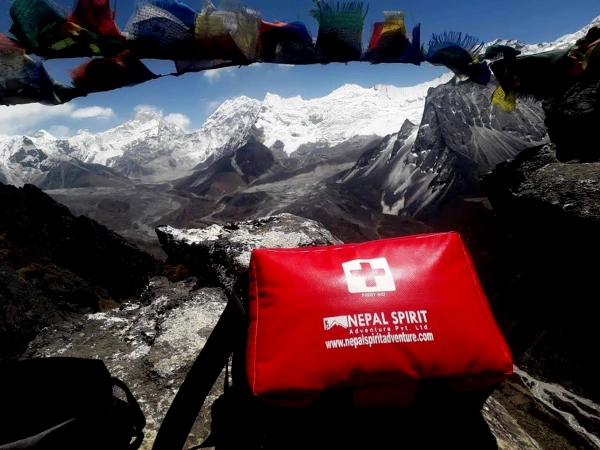
Medical first aid for staff and groups
Excludes
Nepalese visa.
International airfare to and from Kathmandu.
Excess baggage charges on domestic flights (luggage over 15 kg is subject to a fee of approximately USD 1.50 per kg).
Additional nights in Kathmandu due to early arrival, late departure, or early return from the mountain (for any reason) outside the scheduled itinerary.
Lunches and dinners in Kathmandu (and in case of early return from the mountain before the scheduled itinerary).
Travel and emergency rescue insurance (mandatory).
Personal expenses such as phone calls, internet, laundry, bar bills, battery charging, hot showers, bottled or boiled water, and extra porters
Personal trekking and climbing gear.
Personal climbing guide (available on request).
Optional trips or sightseeing are not included in the main itinerary.
The published departure dates for the Mera Peak Climbing expedition are guaranteed to operate. If the scheduled departure date does not match your travel plans in Nepal, please feel free to contact us.
We also offer private Mera Peak climbing trips, which can be arranged on a date that is convenient for you and your group. Private departures are available throughout the year, subject to suitable weather and climbing conditions.
Our team will be happy to customize the itinerary according to your preferred schedule and requirements.
Essential Information
Kathmandu Airport Arrival Pickup
Welcome to Nepal! Upon your arrival at Tribhuvan International Airport in Kathmandu, a friendly representative from Nepal Spirit Adventure will be waiting to greet you in the arrivals hall with a personalized name board.
After meeting our representative, you will be transferred by private vehicle to your hotel in Kathmandu, where you can relax after your journey and prepare for your upcoming adventure.
Later in the afternoon or evening, we will hold a pre-trip briefing at your hotel. During this meeting, we will review your itinerary in detail, explain the services included and excluded in your package, and answer any questions you may have. You will also meet your trekking and climbing guide, who will assist you with the final preparations, inspect your equipment if necessary, and provide important information to help ensure a safe and successful Mera Peak Climbing experience.
Accommodation
During your Mera Peak Climbing adventure, accommodation is carefully selected to provide comfort while maintaining an authentic Himalayan experience.
In Kathmandu, you will stay in a comfortable 3-star hotel on a twin-sharing basis, with modern amenities and breakfast included. Before and after the expedition, this provides an ideal place to relax and prepare for your journey.
Throughout the trek in the Everest region, accommodation is provided in traditional teahouses (mountain lodges). During the climbing section, including Mera High Camp, you will stay in fully equipped expedition tents, offering a safe and comfortable base before your summit attempt.
All accommodations are based on twin-sharing. A single room supplement is available upon request for an additional USD 660. Single rooms are generally available in Kathmandu and at lower-altitude teahouses; however, due to limited facilities in remote mountain areas, they may not be available at higher elevations.
Meals
Your Mera Peak Climbing package includes nutritious meals throughout the trek to keep you energized for the demands of high-altitude trekking and climbing.
While staying in Kathmandu, the package includes daily breakfast at your hotel. During the trekking and climbing portion of the trip, three meals a day (breakfast, lunch, and dinner) are provided.
Breakfast and dinner are served at the teahouse or lodge where you stay each night, while lunch is enjoyed at a local teahouse along the trekking route. All meals are freshly prepared using locally available ingredients, with an emphasis on cleanliness, hygiene, and balanced nutrition.
Most teahouses offer a varied menu featuring traditional Nepali dishes as well as international favorites. The staple meal is Dal Bhat (steamed rice, lentil soup, seasonal vegetables, and pickles), a nutritious and popular choice among trekkers because it provides sustained energy for long days on the trail.
Other menu options may include:
Fried rice and rice dishes
Noodles and pasta
Momos (Nepali dumplings)
Potatoes and seasonal vegetables
Soups
Pizza and French fries (at many teahouses)
Bread, pancakes, porridge, muesli, and egg dishes for breakfast
Most teahouses also sell snacks, soft drinks, bottled water, tea, coffee, chocolate, and alcoholic beverages such as beer. These additional items are not included in the package and can be purchased directly at the lodges.
As you gain altitude, food choices become more limited due to the remoteness of the region. However, the meals remain wholesome, freshly prepared, and designed to support your energy needs throughout your Mera Peak Climbing adventure.
Safe Drinking Water
Staying well hydrated is essential during Mera Peak Climbing and other high-altitude treks in Nepal. We recommend drinking 3 to 4 liters of water per day to reduce the risk of dehydration and help your body acclimatize to the altitude, lowering the chances of Acute Mountain Sickness (AMS).
Safe drinking water is available throughout the trek. Whenever possible, you can purchase sealed bottled mineral water from local shops and teahouses. However, to help reduce plastic waste in the Himalayas, we encourage trekkers to carry a reusable water bottle or hydration bladder.
Natural water sources, including streams, springs, and taps, should never be consumed without proper treatment. If you refill your bottle from these sources, be sure to purify the water using water purification tablets, a portable water filter, or a UV water purifier.
Most teahouses also provide boiled drinking water, which is a safe and environmentally friendly option. The cost of boiled or bottled water typically ranges from USD 1 to USD 2 per liter, with prices increasing at higher elevations due to transportation costs.
We recommend bringing a reusable water bottle and a reliable water purification method to minimize expenses, reduce plastic waste, and ensure you have access to safe drinking water throughout your Mera Peak Climbing adventure.
Experience Required
The Classic Mera Peak Climbing route is suitable for trekkers with a good level of physical fitness and a strong sense of adventure. While previous trekking experience is beneficial, no prior technical climbing experience is required. Under the guidance of our experienced Sherpa climbing team, beginners with proper preparation can successfully summit Mera Peak (6,476 m / 21,247 ft).
During the trek, you should be prepared to walk 5 to 7 hours each day, carrying a light daypack. As the journey reaches higher elevations, the terrain becomes more demanding, and the reduced oxygen levels make trekking more physically challenging than at lower altitudes.
To enjoy your Mera Peak adventure, you should be in good health, have a reasonable level of cardiovascular fitness, and possess a positive attitude, determination, and mental resilience. Regular training before your trip—such as hiking, jogging, cycling, swimming, stair climbing, or strength exercises—is highly recommended to improve your endurance and prepare your body for high-altitude trekking.
Although Mera Peak is considered a non-technical trekking peak, the summit climb requires the use of basic mountaineering equipment, including crampons, an ice axe, a climbing harness, and fixed ropes. Before the summit attempt, our experienced climbing guides provide practical instruction and safety training to ensure you are confident using the equipment.
If you have any pre-existing medical conditions, particularly heart, lung, blood pressure, or respiratory disorders, you should consult your physician before booking the trip. We also recommend informing Nepal Spirit Adventure of any medical conditions or concerns in advance so we can provide appropriate guidance and help ensure a safe and enjoyable Mera Peak Climbing experience.
Our Experienced Trek & Climbing Crew
At Nepal Spirit Adventure, your safety, comfort, and success are our highest priorities. Every Mera Peak Climbing expedition is led by experienced local trekking and climbing professionals who have extensive knowledge of Nepal's mountains, culture, and high-altitude environment.
Our team consists of licensed trekking guides, certified Sherpa climbing guides, assistant guides, and hardworking porters who have been carefully selected for their experience, professionalism, and commitment to providing exceptional service. Many of our guides have more than 10 years of experience leading trekking and mountaineering expeditions throughout the Nepal Himalayas.
All of our trekking guides are licensed by the Government of Nepal and are affiliated with the Trekking Agencies' Association of Nepal (TAAN) and the Nepal Mountaineering Association (NMA). In addition, our climbing guides receive regular training in mountain safety, first aid, altitude awareness, rescue procedures, and climbing techniques to ensure they are fully prepared for every expedition.
Throughout your journey, our guides will not only lead the trek safely but also share their knowledge of the local Sherpa culture, traditions, history, wildlife, and Himalayan landscapes. They are always happy to answer your questions, offer practical advice, and help you make the most of your time in Nepal. You'll also have the opportunity to learn a few Nepali phrases and gain a deeper understanding of the local way of life—experiences that go far beyond a typical travel guide.
For group departures, we assign a trek leader and, depending on the group size, one or more assistant guides to provide additional support. This ensures personalized service and enhances the safety and overall experience of every participant.
To make your trek more comfortable, we also provide one porter for every two trekkers, with a maximum carrying weight of 25 kg. During the climbing section, experienced Sherpa guides accompany the team to provide technical support and ensure a safe summit attempt.
Our experienced crew works together to ensure every Mera Peak Climbing adventure is safe, enjoyable, and memorable, allowing you to focus on the incredible landscapes and the achievement of reaching Nepal's highest trekking peak.
Acclimatization
Proper acclimatization is one of the most important factors for a safe and successful Mera Peak Climbing expedition. At Nepal Spirit Adventure, every itinerary is carefully designed to reduce the risk of Acute Mountain Sickness (AMS) by allowing your body enough time to gradually adjust to increasing altitude.
Ascending too quickly can lead to altitude-related illnesses, which can become serious if not recognized and treated promptly. For this reason, our itineraries include carefully planned acclimatization days, gradual altitude gains, and a sensible trekking pace to maximize your comfort and safety throughout the journey.
Although our itineraries are designed to minimize the risk of AMS, it is important to understand that every person responds differently to high altitude. Age, fitness level, and previous trekking experience do not guarantee immunity from altitude sickness.
Our experienced trekking and Sherpa climbing guides are trained to recognize the early signs and symptoms of AMS. Throughout the expedition, they will closely monitor your health, encourage proper hydration, maintain an appropriate pace, and provide guidance to help you acclimatize safely.
To further reduce the risk of altitude sickness, we recommend drinking plenty of water, eating nutritious meals, avoiding alcohol, getting adequate rest, and immediately informing your guide if you experience symptoms such as headache, nausea, dizziness, unusual fatigue, or shortness of breath.
Your safety is our highest priority. With careful planning, professional support, and responsible acclimatization practices, we aim to provide a safe, enjoyable, and successful Mera Peak Climbing experience in the Himalayas.
Recharging Batteries (Electronic Devices)
Keeping your electronic devices charged during your Mera Peak Climbing adventure is generally straightforward, although charging facilities become more limited at higher elevations.
Most teahouses along the trekking route offer charging services using either the local electricity supply or solar power systems. In Nepal, the standard electrical supply is 220–240 volts, 50 Hz. We recommend bringing a universal travel adapter, as power outlets in Nepal may differ from those in your home country. Travel adapters can be easily purchased in Kathmandu before your trek.
Please note that charging electronic devices such as mobile phones, cameras, power banks, and other batteries is not included in the trek package. Most lodges charge a small fee per device or per hour for using their charging facilities, with prices generally increasing at higher altitudes due to limited power availability.
To ensure your devices remain powered throughout the expedition, we also recommend carrying a high-capacity power bank and spare camera batteries, especially if you plan to take many photos or videos during your Mera Peak Climbing journey.
Group Size
At Nepal Spirit Adventure, we offer Mera Peak Climbing trips as both fixed-departure group expeditions and private tailor-made adventures, giving you the flexibility to choose the travel style that best suits your needs.
Our trips are guaranteed to operate with a minimum of one participant, making them ideal for solo travelers, couples, families, and small groups. Group sizes typically range from a minimum of 2 to 10 participants, while larger private groups can be arranged upon request.
Solo travelers are welcome to book a private trip with a single supplement if they prefer a personalized experience. Alternatively, you can join one of our scheduled fixed departures to share the adventure with like-minded trekkers from around the world.
If our published departure dates do not match your travel plans, simply let us know your preferred dates. We will be happy to arrange a private departure or, when possible, open a new group departure based on your schedule, ensuring a flexible and convenient Mera Peak Climbing experience.
Equipments
Recommendation of Mera Peak Trek Equipment
We recommend the following Mera Trekking equipment. (Cross-check this list when you are packing) If you do not have them with you from your place, remember that you can hire or buy them at a very reasonable price in Kathmandu after you arrive in Nepal.
Head:
-Sun hat or scarf -Light balaclava or warm fleece hat -Sunglasses with UV protection
Upper Body:
-T-shirts -Light and expedition-weight thermal tops -Fleece jacket or pullover -Fleece Wind-Stopper jacket (optional) -Waterproof (preferably breathable fabric) shell jacket -Down vest or jacket
Lower Body:
-Undergarments -Hiking shorts -Lightweight cotton long pants -Light and expedition-weight thermal bottoms -Fleece or wool pants (seasonal) -Waterproof (preferably breathable fabric) shell pants
Feet:
-Thin, lightweight inner socks -Thick, warm wool hiking socks -Hiking boots with spare laces -Camp shoes (sneakers and/or sandals), Gaiters for hiking in winter to the base camp
Hands:
-Lightweight gloves -Heavyweight gloves or mittens with a waterproof shell outer (seasonal)
Accessories:
-Sleeping bag rated to zero DC * -Headlamp (e.g., Petzl Zoom) with spare bulbs and batteries -Trekking Bags/Duffel bag * -Basic First Aid Kit -Large plastic bags - for keeping items dry inside the trek bag -Daypack (approximately 2500 to 3000 cubic inches) -Trekking Poles -Water bottle (2) or camel bag -Toiletries (Small wash towel, Toilet paper, etc.) -Ear Plugs (who knows, some people in the group are snoring) -Lip guard -Passport copies -Pocket knives -Flashlight
-Wet wipes (baby wipes) -Tissue /toilet roll -Antibacterial hand wash
Extras/Luxuries:
-Binoculars -Reading books -Trail Map/guide book -Journal & Pen -Walkman -Pencils and small notebooks -Travel games, i.e., chess, backgammon, Scrabble -Swimming customs
What You Carry for Mera Trek:
For your Mera Trek and Mera Peak Climbing adventure, please prepare your trekking equipment according to the recommended packing list. Pack your main trekking gear in a durable duffel bag or large rucksack, along with a small daypack that you will carry yourself throughout the trek.
Your main luggage containing your clothing and personal equipment will be carried by porters and will be available for you at the teahouse or campsite each evening. Please pack your belongings properly and keep essential items easily accessible.
You should carry a daypack with important personal items such as drinking water, a rain jacket, warm layers, a hat, gloves, a camera, snacks, personal documents, and money. Since weather conditions in the Himalayas can change quickly, it is important to keep extra warm clothing and rain protection in your daypack while trekking.
Packing light but wisely will help make your Mera Peak Expedition more comfortable, safe, and enjoyable.
Mera Peak is one of Nepal’s most famous trekking peaks, located in the Mahalangur Himal range of the Everest (Khumbu) Region in Nepal. Standing at an elevation of 6,476 meters (21,247 feet), it is recognized as the highest trekking peak in Nepal.
Mera Peak offers an incredible Himalayan climbing experience with breathtaking views of some of the world’s highest mountains, including Mount Everest,Lhotse,Makalu,Cho Oyu, and Kangchenjunga. Although it is a high-altitude climb, Mera Peak is considered a non-technical trekking peak, making it an excellent choice for physically fit trekkers who want to experience their first Himalayan summit with proper preparation and guidance.
Yes, Nepal Spirit Adventure provides complimentary airport pickup service from Kathmandu Tribhuvan International Airport for guests arriving before their scheduled Mera Peak Climbing departure date.
If you arrive in Kathmandu earlier than the planned trek start date, we can assist with your airport transfer and help you prepare for your upcoming adventure. Please send us your complete international flight details, including your arrival date and time, so our airport representative can arrange the pickup accordingly.
Early arrival also provides extra time to explore Kathmandu, complete any last-minute preparations, check your trekking equipment, and meet your guide before beginning your Mera Peak expedition.
Yes, the Kathmandu hotel accommodation is included in our Mera Peak Climbing package. We provide comfortable accommodation in Kathmandu with a delicious daily breakfast included.
The package covers your stay in Kathmandu before and after the expedition, allowing you to relax, prepare for the trek, and complete any necessary arrangements before heading to the Himalayas.
For complete details about accommodation, services, costs, and the full itinerary, please refer to our Mera Peak Climbing package and itinerary.
Trip details link:
The Mera Peak Climbing is considered a challenging high-altitude trekking and climbing adventure due to its elevation of 6,476 meters (21,247 feet) and demanding Himalayan conditions. However, it is classified as a non-technical trekking peak, making it achievable for physically fit trekkers with proper preparation, acclimatization, and basic mountaineering training.
The main challenges of Mera Peak Climbing are the high altitude, long trekking days,cold temperatures, and glacier travel rather than difficult technical climbing. Climbers should be comfortable using basic mountaineering equipment such as crampons, an ice axe, and a climbing harness.
With a positive attitude, good physical fitness, appropriate training, and guidance from an experienced Sherpa climbing team, Mera Peak can be successfully climbed by enthusiastic beginners as well as experienced mountaineers.
Yes, the Kathmandu–Lukla or Ramechhap–Lukla round-trip airfare is included in our 18-day Mera Peak Climbing package.
During the peak trekking seasons of March–April and October–November, Lukla flights are often operated from Ramechhap (Manthali) Airport due to increased air traffic at Kathmandu Airport. In this case, we provide a comfortable overland transfer between Kathmandu and Ramechhap, and the transportation cost is included in the Mera Peak Climbing package.
During the remaining months, flights generally operate directly between Kathmandu and Lukla, making the journey more convenient without the need for a transfer to Ramechhap.
Our team will arrange all necessary transportation and flight arrangements according to the current airline schedule, ensuring a smooth start and finish to your Mera Peak Expedition.
Mera Peak Climbing is considered a challenging high-altitude trekking and climbing adventure because of its elevation, remote location, long trekking days, and changing Himalayan weather conditions. Standing at 6,476 meters (21,247 feet), Mera Peak requires good physical fitness, proper acclimatization, and mental determination.
Although Mera Peak is a high-altitude summit, it is classified as a non-technical trekking peak. The main challenges are related to altitude, endurance, glacier travel, and cold temperatures rather than complex technical climbing. Basic mountaineering skills, including the use of an ice axe, crampons, a climbing harness, and rope techniques, are required for the summit section.
With adequate preparation, regular physical training, proper acclimatization, and guidance from experienced Sherpa climbing guides, Mera Peak can be successfully climbed by fit trekkers, including those with limited previous mountaineering experience.
The best time for Mera Peak Climbing is during the spring (March to May) and autumn (September to November) seasons. These periods offer the most favorable weather conditions, stable temperatures, clear skies, and excellent mountain visibility, making them ideal for trekking and summit attempts.
Spring (March–May) is a popular climbing season with warmer temperatures, blooming rhododendron forests, and good conditions for high-altitude climbing. Autumn (September–November) is considered the best overall season due to dry weather, clear views, and stable conditions in the Himalayas.
Although these are the busiest trekking and climbing seasons, the reliable weather and stunning panoramic mountain views make them the most recommended times to attempt the Mera Peak Climbing.
Winter (December–February) is possible for experienced climbers who are prepared for extreme cold and more challenging conditions, while the monsoon season (June–August) is generally less suitable due to rain, cloud cover, and flight disruptions.
To climb Mera Peak, you need several permits and official documents required by the Government of Nepal. The main permits include a Mera Peak Climbing Permit issued through the Nepal Mountaineering Association (NMA) and a Sagarmatha National Park Entry Permit.
You will also need a Khumbu Pasang Lhamu Rural Municipality permit for trekking in the Everest region. These permits help support conservation, local development, and the management of trekking and climbing activities in Nepal’s Himalayan regions.
All necessary permits for the Mera Peak Expedition are arranged by Nepal Spirit Adventure as part of your climbing package. Our team handles the paperwork and permit procedures, allowing you to focus on your preparation and enjoy a smooth trekking and climbing experience in the Himalayas.
The Mera Peak Expedition typically takes around 14 to 18 days, including the trek to and from the mountain, acclimatization days, climbing preparation, and the summit attempt. The exact duration may vary depending on the chosen itinerary, weather conditions, flight schedules, and the overall pace of the trekking group.
A well-planned Mera Peak Climbing itinerary includes sufficient time for acclimatization to help your body adjust to the high altitude and increase the chances of a successful summit. The standard route begins with a scenic flight to Lukla, followed by trekking through the remote Khumbu region before reaching Mera Base Camp and making the summit attempt.
Factors such as individual fitness level, previous trekking experience, altitude adaptation, and Himalayan weather conditions can influence the overall length of the expedition. Allowing some flexibility in your schedule is highly recommended to handle possible weather delays and ensure a safer, more enjoyable Mera Peak climbing experience.
Proper equipment is essential for a safe and successful Mera Peak Climbing adventure. Since Mera Peak is a high-altitude Himalayan climb, you need suitable trekking and mountaineering gear to handle cold temperatures, glacier conditions, and changing mountain weather.
The essential gear required for the Mera Peak Expedition includes:
Mountaineering boots suitable for crampons
Crampons
Ice axe
Climbing harness
Helmet
Carabiners and climbing ropes
Warm and waterproof clothing layers
Down jacket and insulated gloves
Quality trekking boots
Sleeping bag suitable for cold temperatures
Backpack and daypack
Headlamp with extra batteries
Sunglasses and sun protection
Water bottle or hydration system
Personal first-aid and medication supplies
Some technical climbing equipment may be provided by Nepal Spirit Adventure, depending on your package arrangement. We recommend checking the complete equipment list with your trekking agency before departure to ensure you have everything required for a comfortable and safe summit attempt.
If you are unsure about any climbing equipment, our experienced trekking and climbing team can provide expert advice and help you prepare properly for your Mera Peak Climbing journey.
Prior mountaineering experience is not mandatory for the Mera Peak Expedition, but having previous trekking or climbing experience is certainly an advantage. Mera Peak is considered a non-technical trekking peak, although the summit involves glacier travel and requires basic mountaineering skills.
Climbers should be familiar with essential techniques such as using an ice axe, crampons, a climbing harness, and rope systems. For those with limited climbing experience, our experienced Sherpa climbing guides provide basic training and guidance before the summit attempt to help you safely use the required equipment.
The most important requirements for Mera Peak Climbing are good physical fitness, proper preparation, a positive mindset, and the ability to adapt to high-altitude conditions. With adequate training, acclimatization, and professional support, fit trekkers with little or no previous mountaineering experience can successfully attempt the Mera Peak summit.
During the Mera Peak Expedition, accommodation is provided in a combination of comfortable hotels, traditional teahouses, and expedition tents, depending on the location and stage of the journey.
In Kathmandu, you will stay in a comfortable hotel with modern facilities. During the trekking portion, accommodation is arranged in local teahouses (mountain lodges), which provide a simple but authentic Himalayan experience. Teahouses usually offer twin-sharing rooms, shared bathroom facilities, dining areas, and warm meals.
During the climbing section, especially near Mera Base Camp and High Camp, accommodation is provided in well-organized expedition tents. Our climbing crew arranges the necessary camping setup to ensure you have a safe and comfortable environment before your summit attempt.
The cost of Mera Peak Climbing varies depending on the itinerary, group size, season, and services included in the package. On average, a complete Mera Peak Expedition package can cost around USD 2290 to USD 5,000 per person.
The total cost generally includes essential services such as Mera Peak climbing permits, trekking permits, accommodation, meals during the trek and climb, domestic flights, experienced trekking and climbing guides, porters, camping arrangements, and necessary support staff.
Additional expenses may include international flights, travel insurance, personal climbing equipment, extra hotel nights in Kathmandu, personal expenses, charging facilities, snacks, and tips for the trekking crew.
Choosing a reliable and experienced trekking agency is important, as a lower-cost package may not always include the necessary safety measures, experienced guides, quality equipment, or proper support required for a successful high-altitude expedition.
For an accurate price, it is best to check the detailed Mera Peak Climbing itinerary and package inclusions based on your preferred travel dates and services.
The classic Mera Peak Expedition route begins with a scenic flight from Kathmandu to Lukla, the gateway to the Everest region. From Lukla, the trek follows a less-traveled trail through remote valleys, traditional Sherpa villages, and beautiful Himalayan landscapes before reaching the Mera Peak climbing area.
The popular trekking route passes through several picturesque settlements, including Paiya, Pangkongma, Nashing Dingma, Chalem Kharka, and Kothe, before continuing toward Tangnang (Thaknak) and Khare, the main acclimatization and preparation point for the climb.
From Khare, climbers continue toward Mera Base Camp and cross the Mera La Pass before reaching Mera High Camp. The final summit push involves glacier travel on snow and ice using basic mountaineering equipment such as crampons, an ice axe, and ropes. After reaching the summit of Mera Peak (6,476 m / 21,247 ft), climbers enjoy spectacular panoramic views of some of the world's highest mountains before descending back to Lukla and flying to Kathmandu.
The Mera Peak route combines remote wilderness trekking, authentic Sherpa culture, and an exciting Himalayan climbing experience, making it one of Nepal’s most rewarding trekking peak adventures.
Like any high-altitude Himalayan adventure, the Mera Peak Climb involves certain risks that should be carefully managed through proper preparation, responsible planning, and professional guidance. The major challenges include altitude sickness (Acute Mountain Sickness/AMS), extreme weather conditions, glacier travel, falls, and possible avalanches.
The high elevation of Mera Peak (6,476 m / 21,247 ft) means climbers may experience altitude-related symptoms due to lower oxygen levels. Proper acclimatization, a gradual ascent, adequate hydration, and following the advice of experienced guides are essential to reduce the risk of altitude sickness.
Weather in the Himalayas can change rapidly, bringing cold temperatures, heavy snowfall, strong winds, and reduced visibility. The use of appropriate clothing, quality climbing equipment, and flexible scheduling helps manage these mountain conditions safely.
During the summit climb, participants may encounter glacier terrain requiring the use of technical equipment such as crampons, an ice axe, harnesses, and ropes. Our experienced Sherpa climbing guides provide safety instructions and support throughout the climbing section.
For a safe and successful Mera Peak Expedition, we strongly recommend purchasing comprehensive travel insurance that covers high-altitude trekking, peak climbing, emergency evacuation, and medical expenses. With proper preparation, experienced guides, and careful risk management, Mera Peak can be an achievable and rewarding Himalayan adventure.
The Mera Peak Climbing requires a good level of physical fitness, endurance, and mental preparation due to the long trekking days, high altitude, and challenging Himalayan conditions. Although Mera Peak is considered a non-technical trekking peak, reaching the summit at 6,476 meters (21,247 feet) demands proper preparation and commitment.
You should be comfortable walking for 5 to 7 hours per day on varied mountain terrain while carrying a light daypack. Good cardiovascular fitness, leg strength, stamina, and the ability to walk continuously for several days are essential for a successful climb.
Previous trekking or mountaineering experience is helpful but not compulsory. With regular training, proper acclimatization, and guidance from experienced Sherpa climbing guides, fit trekkers with a strong determination and positive attitude can successfully attempt the Mera Peak summit.
We recommend starting your preparation several months before the expedition with activities such as hiking,jogging,cycling,swimming, stair climbing, and strength training. Building your endurance and improving your overall fitness will make your Mera Peak Climbing experience safer, more enjoyable, and more rewarding.
Although it may be possible for experienced mountaineers to attempt Mera Peak independently, climbing without professional support is not recommended due to the high altitude, glacier conditions, changing weather, and remote Himalayan environment.
A successful Mera Peak Climbing expedition requires proper acclimatization, knowledge of high-altitude trekking, basic mountaineering skills, and the ability to use technical equipment such as crampons, an ice axe, harnesses, and ropes. Hiring an experienced climbing guide provides essential safety support, route knowledge, and assistance during the summit attempt.
For most climbers, especially those unfamiliar with Nepal’s high-altitude conditions, it is strongly recommended to join a registered trekking agency with a qualified Sherpa climbing guide. A professional team will help manage permits, logistics, accommodation, equipment, safety procedures, and emergencies, allowing you to focus on enjoying the incredible Himalayan experience.
With the support of an experienced guide and proper preparation, the Mera Peak Expedition becomes a safer and more enjoyable adventure.
Altitude sickness (Acute Mountain Sickness or AMS) is one of the main challenges during the Mera Peak Climbing expedition because the route reaches a high elevation of 6,476 meters (21,247 feet). As altitude increases, the oxygen level decreases, and some climbers may experience difficulty adapting to the thinner air.
Common symptoms of altitude sickness include headache, nausea, dizziness, fatigue, loss of appetite, difficulty sleeping, and shortness of breath. In rare but serious cases, altitude-related illnesses can become life-threatening if not treated properly.
To reduce the risk of AMS, our Mera Peak itinerary is carefully designed with gradual altitude gain and sufficient acclimatization time. Our experienced trekking and Sherpa climbing guides monitor your health throughout the journey, maintain a safe pace, and provide guidance on hydration, rest, and proper acclimatization.
It is important to inform your guide immediately if you experience any symptoms of altitude sickness. If symptoms become severe or continue to worsen, descending to a lower altitude is the most effective treatment.
With proper preparation, a gradual ascent, experienced guides, and responsible trekking practices, most properly prepared climbers can complete the Mera Peak Expedition safely and successfully.
What Our Guests Say?
151 reviews
38 reviews
Nepal Best Trek Company
Abbiamo organizzato con Nepal Spirit Adventure l'ascesa al Mera Peak (6476 m) e devo dire che ci siamo trovati benissimo. Il team si è occupato di tutte le incombenze burocratiche, come permessi di trekking e permessi di vetta, ma...
read more +
Ettore Rovella -Italy
October 31, 2025
Highly recommended Company!!
Thank you, Mr. Ram, and your experience team! Your team did one of the best and outstanding services that we have all received. The result we were able to summit 6476m Mera Peak.
I had a great experience; they took...
read more +
Ettore Rovella -Italy
October 30, 2025
3rd Time with Nepal Spirit Adventure!!
Ottima organizzazione dell'escursione sul Mera Peak! Guida e portatori e trasporti gestiti direttamente dall'agenzi